Explainer video script template, with three real scripts
A short explainer needs fewer words than most people write: our 45- to 60-second films carry 9 to 13 lines and 58 to 82 words on screen. Here is the five-beat template they follow, three real scripts with their timings, and the rules behind every line.
By Ammar Rayes, founder of HeroReel · Updated
The short answer
A 45- to 60-second explainer script has five beats: a moment the viewer recognises, the turn where the problem peaks, the product doing the work once, the payoff, and an end line with the name and the promise. Keep lines short: our films carry 9 to 13 lines and 58 to 82 words in total, all of them on screen.
The five-beat template
Every film we make follows the same five beats. Here they are with BeatCipher's film as the example, at the second each line appears.
| Beat | In BeatCipher's film | What it does | The lines |
|---|---|---|---|
| 1. The moment | 0:00 to 0:10 | A scene the viewer knows from their own life, before the product appears | “There's a part of this song that gets you.” “Wait for it.” |
| 2. The turn | 0:11 to 0:15 | The problem at its sharpest, in a line or two | “1:42. Every time.” “214 plays later, you still can't say why.” |
| 3. The product | 0:16 to 0:35 | The product arrives and does the work once, named the way its makers name it | “So you ask BeatCipher.” “It decodes the psychology inside the track.” “Why it pulls you in.” |
| 4. The payoff | 0:36 to 0:43 | What changes for the viewer, or one more proof | “No lyrics at all? It decodes Mozart too.” “Every decode, saved to your memory bank.” |
| 5. The end line | 0:44 to the end | The promise in one line the viewer can repeat, with the name | “Decode the signal.” |
Fill in the blanks
Copy this and write one line per bracket. If a line needs a second sentence to make sense, it's two lines, or it's the wrong line.
- The moment, 0:00 to 0:10: [A time or a place]. [Who] is [doing the thing your product is about].
- The turn, 0:10 to 0:20: [The problem at its worst, in one line].
- The product, 0:20 to 0:40: [So / That night / Next morning], [product] [does the one thing]. [How it does it, in its own words]. [What comes out].
- The payoff, 0:40 to 0:50: [What's different now]. [One more proof, if you have one].
- The end line, 0:50 to 0:60: [The promise, in under eight words].
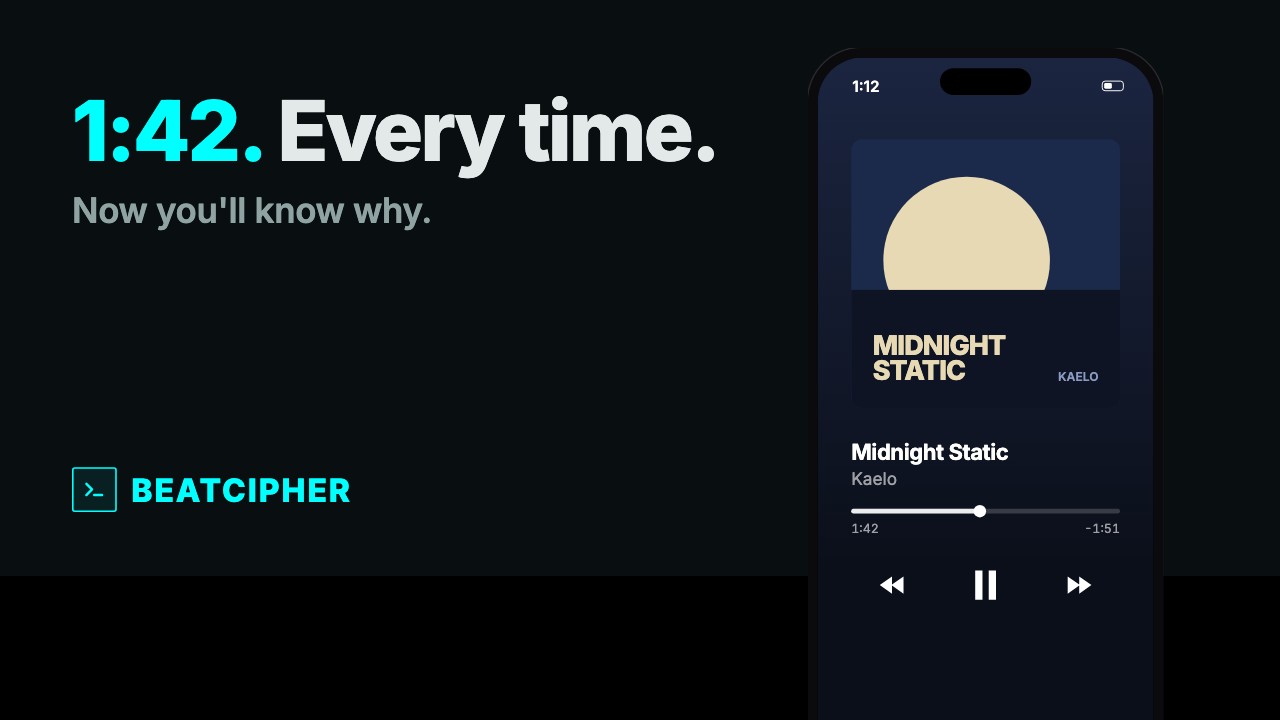
Real script 1: BeatCipher, “The chills”
A 48-second film for an AI app that decodes why a song gets you. The film's soundtrack is the song itself, so the first two lines are the whole setup: the viewer waits for the drop with the listener.
| Time | Line on screen |
|---|---|
| 0:00 | There's a part of this song that gets you. |
| 0:06 | Wait for it. |
| 0:11 | 1:42. Every time. |
| 0:13 | 214 plays later, you still can't say why. |
| 0:16 | So you ask BeatCipher. |
| 0:20 | It decodes the psychology inside the track. |
| 0:22 | Why it pulls you in. |
| 0:27 | The exact second it lands, and why. |
| 0:32 | And what you can take from it. |
| 0:36 | No lyrics at all? It decodes Mozart too. |
| 0:40 | Every decode, saved to your memory bank. |
| 0:44 | Decode the signal. |
12 lines, 71 words.
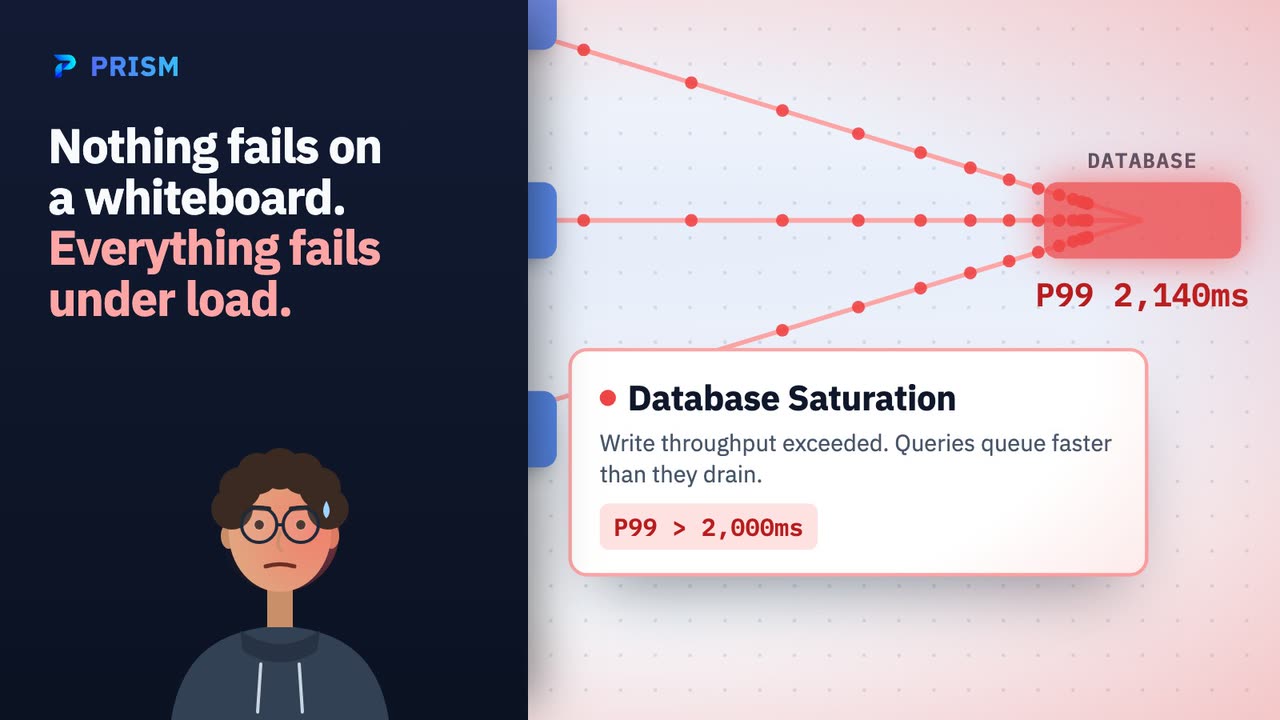
Real script 2: PRISM, “The whiteboard”
A 52-second film for a system design interview simulator. It opens on an interview question, lets the design fail, and gives the mechanism a line of its own: the simulation engine that sends the traffic.
| Time | Line on screen |
|---|---|
| 0:00 | Black Friday. 50,000 requests a second. |
| 0:02 | What breaks first? |
| 0:05 | Nothing fails on a whiteboard. |
| 0:08 | That night, PRISM's simulation engine sends 50,000 requests a second through it. |
| 0:14 | Everything fails under load. |
| 0:17 | PRISM shows why it broke, and what to change. |
| 0:21 | PRISM finds it. You fix it. Run it again. |
| 0:31 | Until it holds. |
| 0:34 | Scored on the five things interviewers check. |
| 0:39 | 50,000 requests a second. What breaks first? |
| 0:42 | This time, they know. |
| 0:44 | Nice. Walk me through the tradeoff. |
| 0:47 | Learn system design by watching it break. |
13 lines, 82 words. The question comes back at 0:39, so the payoff is the same moment, answered.
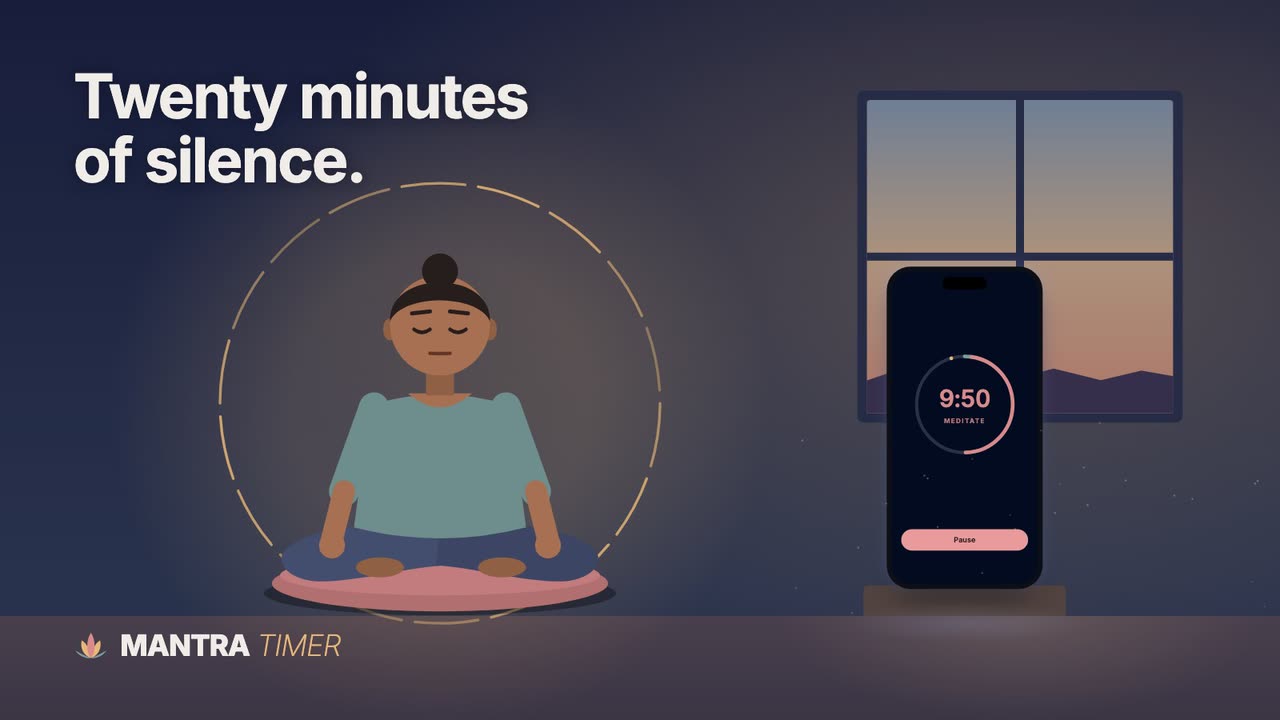
Real script 3: Mantra Timer, “Twenty minutes, interrupted”
A 52-second film for a meditation timer for iPhone. The turn is a single line, because the picture does the rest: one notification after another breaking the silence.
| Time | Line on screen |
|---|---|
| 0:00 | 6:00 AM. Eyes closed. Twenty minutes. |
| 0:08 | Then the app has other plans. |
| 0:14 | Every other meditation app is built for a different practice. |
| 0:21 | Next morning: Mantra Timer. |
| 0:25 | It opens straight to the timer. |
| 0:30 | No streaks. No prompts. No noise. |
| 0:36 | Just twenty minutes of silence. |
| 0:42 | Then one gentle chime. |
| 0:47 | A timer, a mantra, and silence. |
| 0:48 | Made by someone who has meditated every morning for 3,750 days. |
10 lines, 64 words.
Rules for writing the lines
- Start in the customer's world, not on the product. A time and a place set the scene in four words: “6:00 AM. Eyes closed. Twenty minutes.”
- One idea per line, short enough to read in the seconds it's on screen.
- Check every “because”, “so” and “before” against how the problem really works. A line that sounds right but isn't loses the people who know.
- Show the mechanism once, named the way the product's makers name it: “PRISM's simulation engine”, not “our AI”.
- Say what the product leaves out when that's the point: “No streaks. No prompts. No noise.”
- End on a promise the viewer can repeat: “Learn system design by watching it break.”
- Write for the sound off. Every line is on screen, so the film works muted in a feed and on a landing page.